

October 12, 2026
Mold in the Bathroom: Why It Keeps Coming Back and How to Actually Fix It
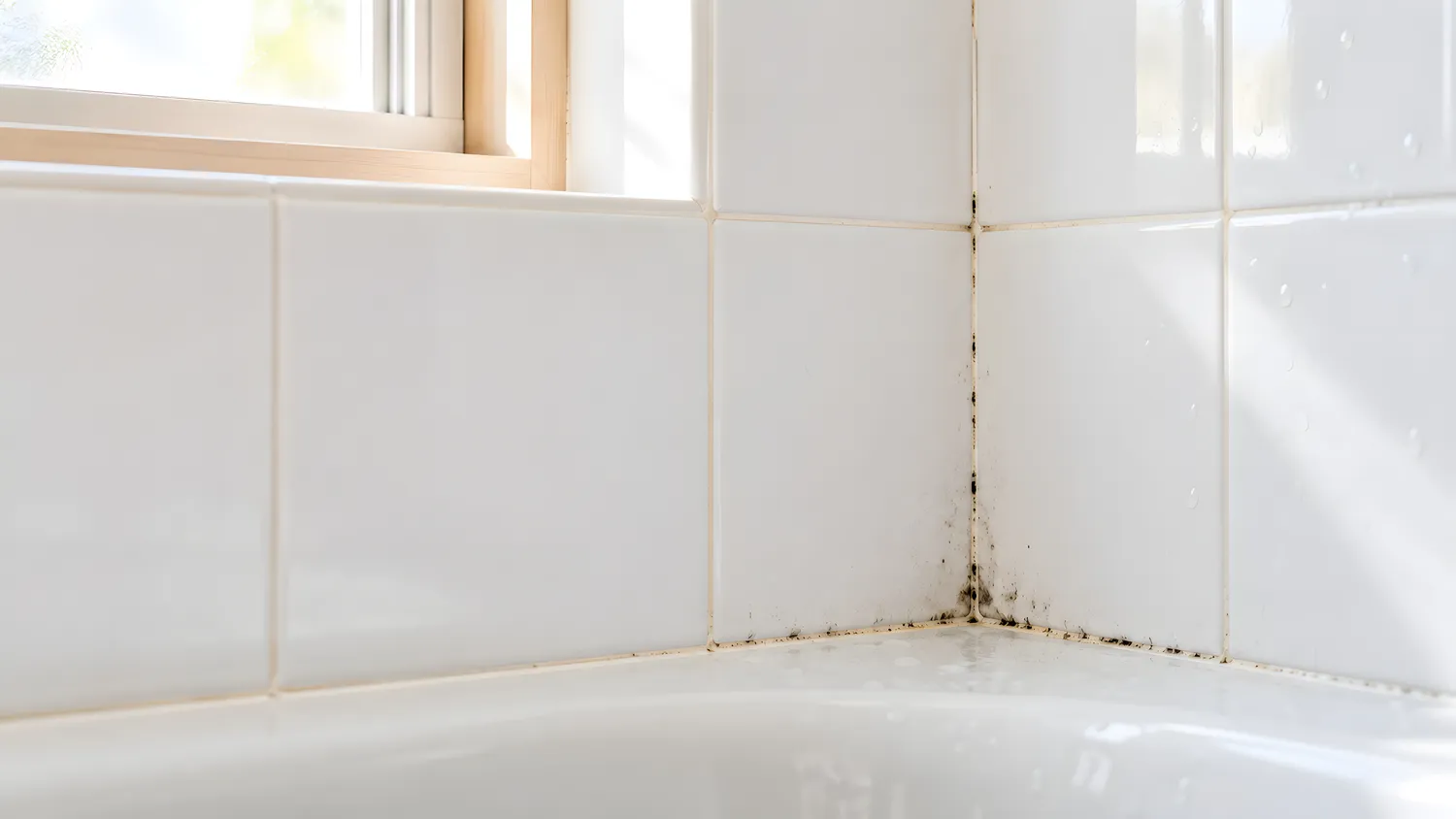
You clean it. It looks fine for a while. Then it’s back — the same grey speckling on the ceiling, the same dark line where the tile meets the tub, the same shadow creeping across the grout in the corner.
That cycle tells you something important: mold is not the problem. Mold is the symptom. It grows where there’s persistent moisture, and if it keeps returning to the same spot after cleaning, the moisture is still there. Scrubbing treats the visible result while leaving the cause untouched.
Every authority on the subject agrees on the sequence, and the EPA states it plainly in its homeowner guide to mold and moisture: fix the water problem first, then clean up the mold. Reverse that order and you’ll be back with a sponge in a few months.
So the useful question isn’t “how do I remove this?” It’s “where is the water coming from?” — and the location of the growth usually tells you.
What the Location Is Telling You
On the ceiling
Almost always a ventilation problem. Hot shower steam rises, hits the coolest surface in the room, and condenses. If it can’t be exhausted, it sits there.
Ceiling mold concentrated directly above the shower points at inadequate airflow. Ceiling mold spread more broadly across the room, especially on a top-floor bathroom, can also indicate a cold ceiling — an under-insulated attic above, letting the drywall run cold enough for condensation to form across a wide area.
If it’s directly around the exhaust fan housing, the fan itself is often the culprit: ducted into the attic instead of outside, or ducted outside through a line that sags and collects water.
In a corner on an exterior wall
This is the classic pattern in older suburban homes here, and it’s a temperature problem rather than a plumbing one.
Corners are where insulation is thinnest and framing is densest, so the interior surface runs colder than the surrounding wall. In an Evanston or Wilmette home built before modern insulation standards — or one where the wall cavity was never properly filled — that corner can drop below the dew point of humid bathroom air during a northern Illinois winter. Water condenses on the surface, and mold follows.
Cleaning does nothing here. The fix is some combination of better ventilation, better insulation, and lower indoor humidity.
Along the tub or shower base
Where tile meets a tub or shower pan, the joint should be filled with flexible sealant, not grout. When that sealant fails — or when rigid grout was used there and cracked — water gets behind it.
Black growth along that line is extremely common and often shallow, but it’s worth checking whether it’s surface mildew on old caulk or something feeding on moisture that’s already behind the tile.
In the shower grout
Some darkening of cement grout in a shower is ordinary residue and hard water, not a structural issue. Persistent black growth that returns immediately after cleaning suggests the joints are staying saturated — poor ventilation, standing water on horizontal surfaces, or grout that’s absorbing and holding water.
This is one of several reasons the choice between epoxy and cement grout matters more in a shower than anywhere else in the house. It’s also why a shower niche needs a sloped sill — a flat one keeps water sitting against grout permanently.
Spreading on a wall away from the shower, or on the ceiling below
This one deserves attention. Growth in a spot with no obvious source of steam usually means water is arriving from somewhere it shouldn’t be — a supply line, a drain connection, or a failed shower pan.
A stain on the ceiling below a bathroom is the version of this that homeowners notice first, and it means water has been getting into the structure for a while.
The Detail That Causes Most of It: Ventilation
Most bathroom mold in this region traces back to ventilation that either isn’t there, isn’t big enough, or doesn’t actually go anywhere. It’s the least glamorous part of a bathroom and the one with the largest effect on how the room ages.
Sizing
The Home Ventilating Institute’s bathroom ventilation guidance gives a simple rule for typical rooms: for bathrooms up to 100 square feet, provide roughly 1 CFM of exhaust per square foot of floor area, which works out to about eight air changes per hour. An 8-by-5 bathroom comes to 40 square feet, so a fan rated around 40 CFM meets the recommendation.
For larger rooms — primary bathrooms above 100 square feet — HVI shifts to a fixture-based calculation instead, assigning airflow per tub, shower, and enclosed toilet compartment. A large bath with several fixtures needs considerably more than the floor-area rule would suggest.
Separately, the ventilation standard that many jurisdictions reference sets a floor of 50 CFM for intermittent bathroom exhaust, or 20 CFM if the fan runs continuously. Note that enclosed toilet compartments need their own ventilation — a fan on the far side of the room doesn’t serve them.
Sound
A fan nobody turns on ventilates nothing. Fan noise is measured in sones, and quieter models exist across the range. This isn’t a comfort luxury; it’s the difference between a fan that runs long enough to clear the humidity and one the household avoids. If your current fan sounds like a small aircraft, that’s a functional problem, not just an annoying one.
Where the air goes
This is where we find the most failures when we open ceilings.
Ducted into the attic. Common in older installations and thoroughly wrong. The moisture doesn’t leave the house — it’s deposited into the attic, where it condenses on the underside of the roof deck. Bathroom mold plus attic sheathing problems frequently share this single cause.
Ducted to the outside, but badly. Long runs of flexible duct that sag, kink, or run uphill collect condensate and choke airflow. Duct that’s undersized for the fan’s rating strangles it. A fan rated at a given CFM only achieves that rating under ideal conditions; real-world performance depends heavily on the duct.
Terminated poorly. A damper that sticks shut, a screened cap clogged with lint, or a termination pointing back into a soffit vent all defeat the system.
No makeup air. A fan can only exhaust what it can replace. A door with no undercut and no gap seals the room, and the fan struggles against it.
Run time
Humidity doesn’t clear the moment the shower stops. A fan switched off as you leave the room has done maybe half its job. A timer switch or a humidity-sensing control that runs the fan on past the end of the shower is one of the highest-value small upgrades in a bathroom — and something we build in as standard on bathroom remodeling projects.
A window is not ventilation
Especially not here. Nobody opens a bathroom window in a northern Illinois January, which is exactly the season when indoor humidity and cold surfaces combine worst. A window is a nice supplement in July and irrelevant when it matters.
The Winter Problem Specific to This Area
Bathroom mold behaves differently in a cold climate, and it’s worth understanding why so many local homes develop it in the same months.
In winter, indoor air holds moisture while exterior wall and ceiling surfaces run cold. The larger that temperature difference, the more readily water condenses on those surfaces. A bathroom generates far more humidity than any other room, so it’s where the problem shows up first.
That’s why bathroom mold in the northern suburbs often appears seasonally — worse from late fall through early spring, quieter in summer. It’s also why the fix frequently involves the building envelope, not just the fan: insulation in the exterior wall cavity, insulation and air sealing above the ceiling, and attention to any spot where the wall assembly runs cold.
It’s the same physics that causes trouble in below-grade spaces, which is why moisture management is central to how we approach basement finishing as well.
There’s also a subtler version that hides inside the wall. Shower steam exists as vapor as well as liquid, and technical guidance on water management in tiled showers notes that a membrane rated to stop liquid water doesn’t necessarily slow vapor transmission — vapor that reaches a cold wall cavity is what causes mold growth inside walls and rot in framing. This is a real consideration for any shower built against an exterior wall in this climate.
Cleaning It, and Knowing When Not To
For a small patch on a hard, non-porous surface, homeowner cleanup is reasonable. The EPA’s mold cleanup guidance covers the practical approach.
The widely cited threshold: when visible growth covers more than roughly 10 square feet — about a three-by-three-foot patch — or where there’s been significant water damage, the EPA advises consulting its more detailed remediation guidance or bringing in someone with mold experience. That line is about containment and safe handling, not about the mold suddenly becoming more dangerous at a particular size.
Two things worth stating clearly:
Don’t paint over it. Covering mold without removing it doesn’t stop the colony — it grows under the coating and the problem continues, hidden. “Mold-resistant” paint is a reasonable finish choice in a properly ventilated bathroom and a useless one over an active problem.
The visible patch is often smaller than the actual one. Surface growth on drywall frequently indicates more behind it. This is a good reason not to assume a cosmetic fix is sufficient, particularly if the same spot has come back repeatedly.
What We Find Behind the Tile
When we open a bathroom that’s had a recurring mold problem, a handful of causes come up again and again:
- No waterproofing membrane behind the shower tile, or an obsolete one — common in older installations where tile was set over a substrate that was never intended to stay dry.
- A fan ducted into the attic, sometimes for decades.
- An exterior wall cavity with little or no insulation behind the shower.
- Rigid grout in movement joints at corners and along the tub, cracked and letting water past.
- A failed shower pan quietly wetting the subfloor.
- Drywall used in a wet area where cement board or a proper backer should have been.
None of these is fixed by cleaning. Several are only fixable during a remodel — which is why a bathroom that keeps growing mold is often telling you something about its age and construction rather than about your cleaning habits.
Designing Mold Out During a Remodel
If you’re renovating, this is the moment to eliminate the causes rather than manage the symptoms:
- A correctly sized, quiet fan on a timer or humidity sensor, ducted in rigid or smooth-wall duct to an exterior termination.
- A continuous waterproofing membrane behind all wet-area tile.
- Insulation and air sealing in exterior walls and the ceiling above.
- Flexible sealant, not grout, at every change of plane.
- Sloped horizontal surfaces — niche sills, benches, curbs — so water leaves instead of pooling.
- Grout chosen for the conditions, with stain- and moisture-resistant products where they earn their place.
- A layout that doesn’t trap humidity in a dead corner, which starts at the bathroom layout stage.
- Good lighting, mundanely enough — you can’t notice a small problem early in a dim room. Our post on bathroom lighting covers the broader case.
Frequently Asked Questions
Why does mold keep coming back after I clean it? Because the moisture source is still present. Cleaning removes the growth, not the conditions that produced it. Recurrence in the same spot is diagnostic information — it tells you where the water is.
Is black mold in the bathroom dangerous? Colour is not a reliable indicator of species or risk, and identifying it visually isn’t possible. Public health guidance is consistent: treat any significant indoor mold growth as something to remove and, more importantly, to prevent by controlling moisture. Anyone with respiratory conditions or immune concerns should be more cautious about handling cleanup personally.
Does bleach kill mold? It removes surface discoloration on non-porous materials. On porous surfaces like drywall or grout, it can leave the growth beneath while adding moisture. It also degrades cement grout and some sealers over time. The reason mold returns after bleaching is usually that the moisture was never addressed.
How do I know if my bathroom fan is big enough? Measure the room’s floor area and compare it against the roughly 1 CFM per square foot guideline for rooms up to 100 square feet, then check the fan’s rating. But sizing is only half of it — where the duct goes and how it’s run matter just as much. A correctly sized fan on bad ductwork underperforms badly.
Can mold be growing inside my walls? It can, particularly where a shower sits against an exterior wall in a cold climate, or where waterproofing has failed. Persistent musty smell without visible growth, or staining that reappears through paint, are reasons to investigate rather than repaint.
Should I remodel or just fix the mold? Depends what’s causing it. A ventilation upgrade is a targeted fix. But if the underlying cause is missing waterproofing, an obsolete shower assembly, or a wall that was never insulated, you’re looking at work that means opening the room anyway.
General note: this article covers the building side of bathroom moisture. Questions about health effects belong with a medical professional, and large or contaminated-water situations belong with a qualified remediation contractor.
Getting to the Cause
A bathroom that keeps growing mold is a bathroom telling you something about how it was built. Sometimes that something is small — a fan that’s too weak or ducted to the wrong place. Sometimes it’s a shower that was never properly waterproofed and has been quietly wetting the structure for years.
We’ve been remodeling bathrooms across the northern Chicago suburbs and the North Shore since 2002, and we’d rather find the cause than cover it. You can see completed projects in our gallery, and there’s more on creating a lighter, better-ventilated space in our post on achieving a bright and airy bathroom remodel.
We serve our full service area, including Arlington Heights, Northbrook, Wilmette, Park Ridge, Lake Zurich, Glenview, Evanston, Skokie, and Mount Prospect.
If mold keeps returning to the same place in your bathroom, get in touch and we’ll take a look at what’s actually behind it.